
A Collection of Sketches by Jean-Pierre Martinez
Contemporary fables about the world as it is… and above all as it is going wrong.
In a series of seemingly self-contained short scenes that nonetheless echo and resonate with one another, strangely human animals and humans on the verge of losing their humanity question their troubled existence and their uncertain future. A political yet humorous reflection on the fragility of the human condition and the dangers currently threatening our democracy.
In this collection of 23 short sketches, Jean-Pierre Martinez presents a contemporary bestiary in which each animal embodies a facet of humanity.
Termites, bees, crows, birds of prey and parrots become mirrors of our political, social and moral excesses.
Through minimalist dialogues blending dark humour, political satire and theatre of the absurd, these short pieces explore:
– single-track thinking and conformity
– authoritarianism and fear
– consumer society
– exploitation and inequality
– the loss of critical thinking
– the mechanical repetition of opinions
Each sketch functions as a modern fable—at once witty, biting and clear-sighted.
Animals and Men belongs to the tradition of committed short-form theatre, somewhere between Ionesco and contemporary satire, offering an accessible and hard-hitting reflection on our times.
List of sketches
1 – The Termites
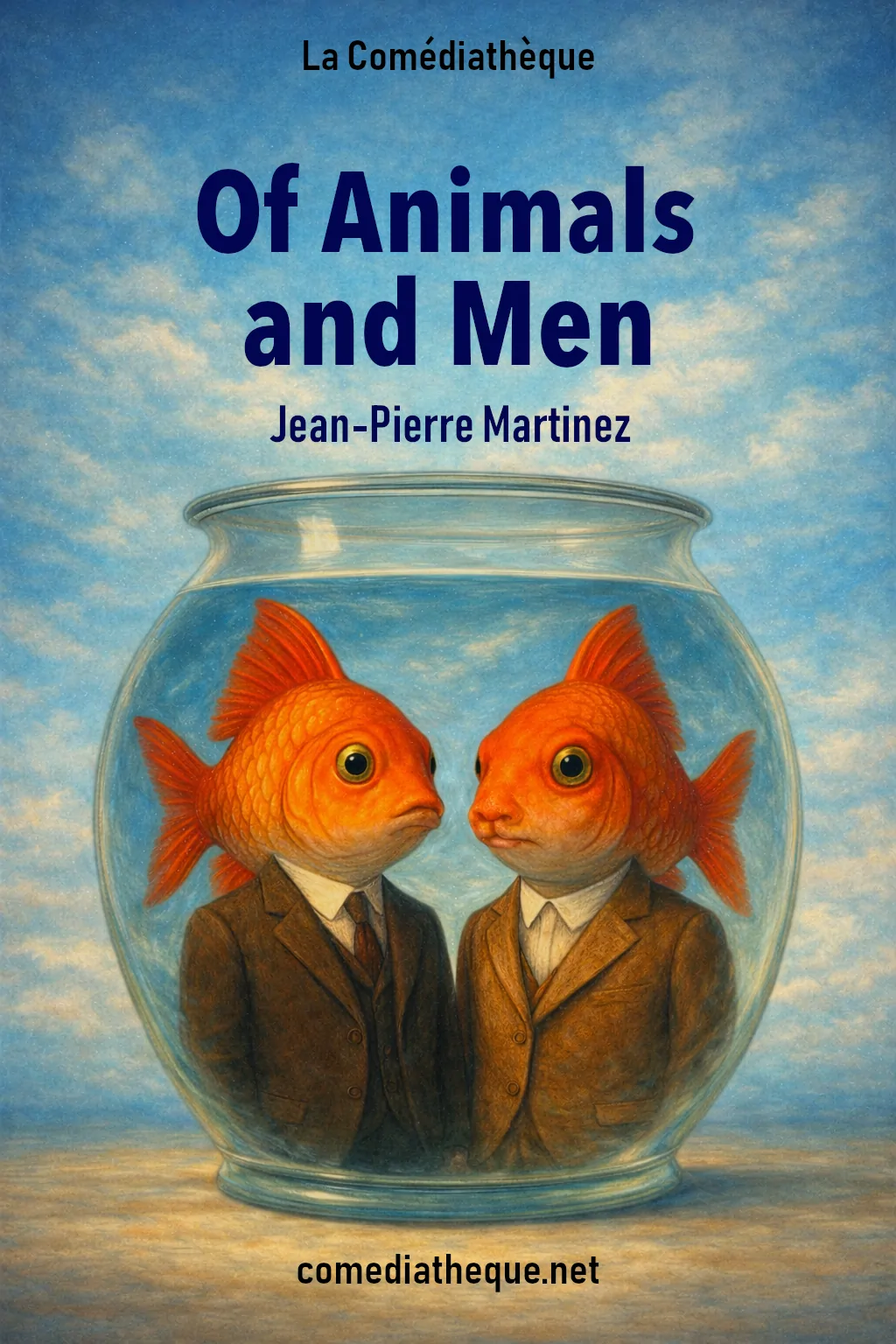
2 – The Goldfish
3 – The jackasses
4 – The Sloths
5 – The Hydra
6 – The Pigeons
7 – The Bear
8 – The Doves
9 – Man’s Best Friend
10 – The jackasses again
11 – Birds of Prey
12 – The Butterflies
13 – The Scavengers
14 – The Hens
15 – The Old Crabs
16 – The Fish
17 – The Bees
18 – The Migrants
19 – The Predators
20 – The Toads
21 – The Crows
22 – The Prey
23 – The Parrots
Download the complete collection for free (PDF)
Thematic Analysis – Of Animals and Men
This comedy of sketches relies on a very simple device—two voices, almost always anonymous (“One” and “Two”), a minimal setting, a rapid ending—to express extremely dark truths about our time. Beneath its apparent lightness, Of Animals and Men is a political and moral fable, halfway between La Fontaine and Orwell, revisited by a contemporary humorist.
1. Overall Form and Dramatic Device
The 23 short scenes follow the same dramatic grammar:
- Two unnamed characters (One / Two), interchangeable and archetypal.
- A place and situation rarely described, merely suggested by a line or two (“we’re butterflies,” “we’re hens,” “we’re at the bar”…).
- A fast-paced ping-pong dialogue made of questions and minimalist responses (“Oh, really…?”, “I don’t know…”, “Well…”).
- A gradual build-up of the idea, often from a detail or misunderstanding,
- A brief, sometimes cruel ending that recontextualizes everything (the termites, the extermination of hens, the toad / Prince Charming, the arrested neighbor, the bricked-up windows in Afghanistan…).
This device creates a kind of “dialogued thought laboratory.” There is little psychology and no classical plot: these are micro-parables in which the idea itself becomes the true protagonist.
2. Animals as a Mirror of Humanity
The title sets the program: sometimes humans speak about animals; sometimes animals speak like humans. In every case, the mirror works both ways.
Animals to Speak About Humans
- Termites represent totalitarian regimes and the masses gnawing away at their own freedoms.
- Fish embody short-term memory failure, social and media amnesia.
- Sloths suggest a slow, poorly adaptable humanity that survives because it is no longer even appetizing.
- Hens and avian flu evoke collective fears, sacrificial logic, and the question of migrants.
- Bees illustrate the division of labor and exploitation (all produce, none truly benefit from the honey).
- Crows, toads, butterflies, etc., reflect stigmatization, biological destiny, or tragically short-lived conditions.
Humans Behaving Like Social Animals
In The Termites or The Hydra, humans become pack animals: surveillance, fear, conformity, erasure of the individual. In The Birds of Prey and The Scavengers , survival becomes purely instinctive: eat, keep living “as long as it’s not us.”
The bestiary enables a double movement:
→ To distance reality through fable.
→ But also to render human reality more brutal by reducing it to an “animal” level.
3. A Deeply Political and Moral Comedy
Many sketches are permeated by explicit political anxiety.
The Rise of Authoritarianism and Extremes
- The Termites: a clear trajectory—from “freeing speech” to single-track thinking, from censorship to self-censorship, from laws transgressed to laws rewritten. A parable about normalization, authoritarian drift, and generalized surveillance.
- The Prey: a climate of raids, fear, guilty relief (“I was relieved it wasn’t my house”), arbitrary arrests where no one remains to greet, learning Russian “just in case they invade us,” parallels with the Occupation and Napoleon, bitter humor about anticipatory collaboration and resignation.
Religion, Obscurantism, and the Regression of Rights
- The Hydra: a Martian-like return to the religious question—Afghanistan, abortion in the United States, new religious wars, reversal of stigma (the atheist urged to keep a low profile). The text plays on Marx’s metaphor of religion as opium, contrasting free communion wafers with the luxury of opium and cocaine.
Ecology, Collapse, and Contemporary Toxicity
- The Termites, The Birds of Prey: rising waters, climate skeptics in power, toxic food and water, heavy metals in chocolate, pesticides, plastics.
- Bees: industrial agriculture, migratory beekeeping, the disappearance of honey replaced by “vile molasses.”
- The Migrants: “them in the sun, us at the slaughterhouse,” mass culling logic (avian flu) and resentment toward those who move.
A Global Diagnosis of Humanity
- The Predators: faced with hypothetical extraterrestrials, the verdict is merciless: inequality, programmed self-destruction, colonization already tested by humans themselves.
The play thus combines social comedy (bar, couple, holidays, neighbors…) with moral and political tragedy (dictatorships, extinction, catastrophe). Laughter becomes the vehicle for a deeply pessimistic vision of our era.
4. Humor: Burlesque, Absurd, and Dark
The comic effectiveness draws on several registers:
Verbal Comedy
- Misunderstandings and word shifts
- Repetitions and refrains: “I don’t know…”, “Yeah…”, “That’s how it is”, “I think about it, then I forget…”
Situational and Displacement Comedy
- A man discovering he is in a sadomasochistic club without realizing it (The jackasses).
- A dead jackass placed on a chair in the middle of a roundabout, triggering an absurd investigation (The jackasses again).
- Butterflies with no mouth or digestive system, yet obliged to reproduce “to make larvae.”
- The fish’s one-second memory applied to a pointless dialogue.
Dark Humor and Assumed Cynicism
- “If we’re going to die of something, we might as well die with a full stomach.”
- “At least it’s not happening to us.”
- “Even friends, even family—they don’t give a damn about us either.”
This humor does not neutralize the darkness; it underlines it. The play clearly aligns with critical comedy: making us laugh in order to make us ashamed of laughing.
5. A Dramaturgy of Repetition and Forgetting
Two structural motifs run throughout:
Repetition
The situations resemble each other: two voices, one subject, lamentation, rationalization, a punchline. Figures of speech (proverbs, pseudo-scholarly anecdotes, cultural references) return in variation. The cumulative effect suggests not a single dysfunction, but a systemic one.
Forgetting and Irresponsibility
- The goldfish unable to remember what was just said.
- Characters confessing, “I think about it, then I forget.”
- Neighbors relieved that “the other one” was arrested.
- Dinner guests thinking about world hunger while helping themselves to thirds.
No sketch resolves anything: each ends in “Blackout.” Both a stage direction and a symbolic statement. The curtain falls, but the problem remains.
Of Animals and Men functions as a catalogue of ordinary micro-apocalypses—political, ecological, moral, spiritual. Humans appear alternately as not very clever animals, and as beings capable of lucidity… yet incapable of action.
The strength of the play lies precisely in this gap: a sharp awareness of disaster, conveyed through relentless humor, and the impossibility—or refusal—of changing anything at all.